Gorgar Preview Image
Machine Description
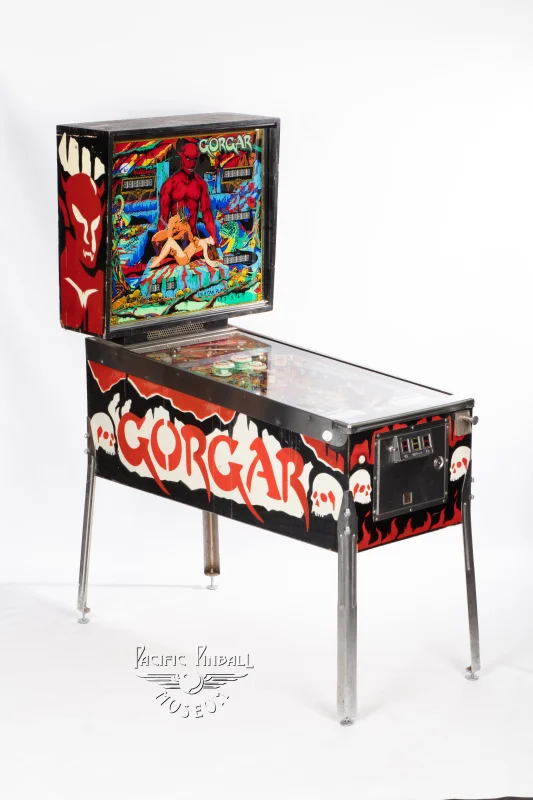
When Williams Electronics released Gorgar in 1979, pinball players encountered something new: a machine that could speak. Its vocabulary was limited to seven words—“Gorgar,” “speaks,” “beat,” “you,” “me,” “hurt,” and “got”—uttered in a halting, synthetic rasp. To modern ears, the phrases sound quaint, almost comic. At the time, though, they were revelatory: proof that pinball, long reliant on bells, buzzers, and the clatter of steel, had entered a new age of electronic voice.
The machine’s conceit was straightforward: face off against Gorgar, a crimson demon rendered in lurid, gothic brushstrokes by the artist Konstantin Kotovsky. The playfield was stocked with familiar devices—bumpers that popped, targets that dropped, ramps that delivered the ball with theatrical menace. Yet the novelty lay in the voice itself, triggered by each well-placed shot. Speech, in pinball, became not just decoration but participation: the game seemed to notice you, even taunt you.
Behind the scenes, designer Eugene Jarvis and his colleagues were feeling their way toward a new relationship between player and machine, one built on a thin but thrilling illusion of dialogue. Gorgar was not a runaway hit, but its run of fourteen thousand units gave it a firm foothold in the arcades of the early eighties. More importantly, it proved that a game could talk back—a modest step that opened the door to the booming, digitized soundscapes of pinball’s future. Today, collectors prize Gorgar not only for its devilish artwork but for the uncanny moment it represents: the first time a pinball machine found its voice.