Humpty Dumpty Preview Image
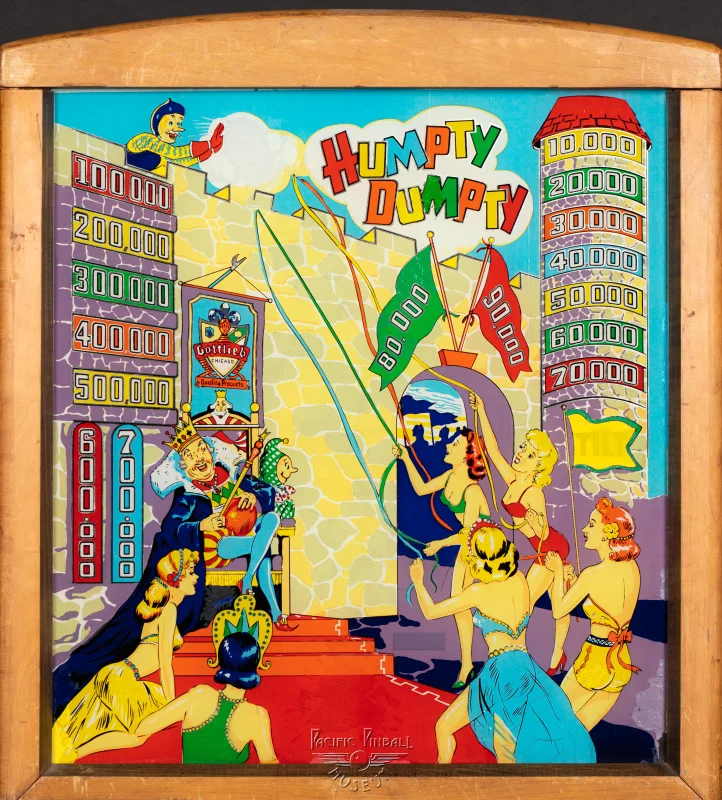
Machine Description
Content Under Review
Help us improve this content
Your support accelerates our content verification efforts.
Support Our WorkHumpty Dumpty, released by D. Gottlieb & Co. in 1947, holds the distinction of being one of the most historically significant pinball machines ever created, as it was the first pinball machine to feature player-controlled flippers. This revolutionary innovation, invented by Harry Mabs, transformed pinball from a game of chance into a game of skill, fundamentally changing the entire industry and establishing the basic gameplay mechanics that would define pinball for decades to come.
The machine's design was relatively simple by modern standards, featuring six flippers - two pairs positioned in the middle of the playfield and one pair near the bottom. These pioneering flippers were quite different from modern ones, being shorter and powered by a weak electromagnetic coil that produced a distinctive 'tick' sound when activated. The artwork and theme were based on the classic nursery rhyme character Humpty Dumpty, featuring colorful artwork of the egg-shaped character on the backglass and playfield.
Humpty Dumpty's success was immediate and profound, quickly leading to the adoption of flippers across the entire pinball industry. The game's introduction helped legitimize pinball in many jurisdictions where it had been banned as a gambling device, as the flipper mechanism clearly demonstrated player skill as a key component of the game. While only around 2,000 units were produced, its influence on game design cannot be overstated.
The machine's legacy lives on as the progenitor of modern pinball, marking the transition from pre-flipper 'pitch and plunge' games to the interactive gameplay we know today. Original Humpty Dumpty machines are highly sought after by collectors and museums, with surviving examples considered priceless artifacts of pinball history.